

بِسْمِ اللَّهِ الرَّحْمَٰنِ الرَّحِيمِ
Who is a Muslim?
Notes on the word Allah uses for those who submit
I was reading Surah Al-Baqarah and I came to two ayahs sitting next to each other that would not let me move on. In 2:111, the Quran reports the claim of the Jews and the Christians: none will enter Paradise except those who are Jews or Christians. In 2:112, Allah corrects them in a single word: bala — on the contrary — and gives the actual condition. Whoever submits his face to Allah, while being a doer of good, has his reward.
That is the first time the s-l-m root appears in the Quran. The first occurrence is also the definition. And the definition is given as a correction of tribal claim-making. Jew, Christian — and I would add, if I’m honest, Sunni, Hanafi, Pakistani, Desi — these are labels we made for ourselves. Our Creator had only one. Muslim. One who has surrendered. This essay starts at 2:112 and follows the word from there.
I am not a scholar. I am someone who started reading the Quran and kept finding things that stopped me. This was the first one, and it became the inspiration for the rest of the series.
The Question
The question came to me the way most of these questions come to me — not from someone asking me, but from sitting with the Quran and noticing something I hadn’t before. I was reading Surah Al-Baqarah, working my way through the long passage where Allah is responding to the claims of the Jews and the Christians, when two ayahs landed next to each other and refused to let me move on.
The first one, 2:111, reports the claim itself. And they say, none will enter Paradise except those who are Jews or Christians. The Quran does not stop to be polite about it. It calls this amaaniyyuhum — their wishful thinking — and challenges them to bring their proof.
The next ayah, 2:112, gives the correction. The first word is bala. On the contrary. And then it tells me what the actual qualification is. Not a tribe. Not a name. Two states of a person, joined together. Whoever submits his face to Allah, while being a doer of good, will have his reward with his Lord.
I sat with that pair of verses for a long time. What lodged in me was not just the definition — though the definition is the heart of it. What lodged in me was the frame. The first time the Quran uses any form of the word muslim, it is using it to dissolve a tribal claim. The labels I had been carrying around for myself, inherited and worn proudly — Muslim by family, Sunni by school, Hanafi by jurisprudence, Pakistani by birth — the Quran was telling me, gently, that these are not what Allah uses to sort us. They are man-made. Our Creator gave us one name. One label. Muslim. One who has submitted, and is doing good while doing so.
That is where this essay starts, and it is the seed of the whole series. I went and made a list of every place in the Quran where someone is named by that word. Every place. 23 ayahs. This is what fell out.
Where the Word Begins
The Arabic root behind the word is س-ل-م — the same root that gives us salaam, peace, and silm, safety, and that turns slightly into aslama, to surrender, to give yourself over. Islam is the verbal noun — the act of surrender. Muslim is the active participle — one who is, in this moment, doing the thing. Grammatically built like “runner” or “reader.” A person sleeping is not currently a runner. A person not submitting is not, in the moment, a muslim. The word does not let me coast.
The first time the root appears in the Quran is in 2:112, and the first time it appears, it is being used to define what it means. That is the part I want to sit with. Allah does not let the word arrive in the Quran as a label floating free. He arrives it already wired to a definition, and the definition is two conditions stitched together by a single word, wa.
The First Occurrence — A Close Reading of 2:112
The claim being refused — 2:111
وَقَالُوا۟ لَن يَدْخُلَ ٱلْجَنَّةَ إِلَّا مَن كَانَ هُودًا أَوْ نَصَٰرَىٰ
Wa qaaloo lan yadkhula al-jannata illaa man kaana hoodan aw nasaaraa
“And they say, ‘None will enter Paradise except one who is a Jew or a Christian.’ That is [merely] their wishful thinking. Say, ‘Produce your proof, if you should be truthful.’”
بَلَىٰمَنْ أَسْلَمَ وَجْهَهُۥ لِلَّهِوَهُوَ مُحْسِنٌۭفَلَهُۥٓ أَجْرُهُۥ عِندَ رَبِّهِۦ
Balaman aslama wajhahu lillahwa huwa muhsinunfalahu ajruhu inda rabbihi
The Refusal
بَلَىٰ
Bala
The opening word — "on the contrary" — refusing the tribal claim of the previous ayah, that only Jews or only Christians enter Paradise. The Quran clears the table before it gives the answer.
Condition I — External Surrender
مَنْ أَسْلَمَ وَجْهَهُۥ لِلَّهِ
man aslama wajhahu lillah
Whoever submits his face to Allah. Wajh — the most public, presentable, identity-bearing part of a person. The face you turn toward others, and toward Allah in sajda. To submit it is to surrender the visible self.
Condition II — Inner Goodness
وَهُوَ مُحْسِنٌۭ
wa huwa muhsinun
While being muhsin. From ihsan — worshiping Allah as if you see Him, because He sees you. Doing good with care, with sincerity, as if watched. The inside life joined to the outside act. Joined by wa: simultaneously, not sequentially.
The Reward
فَلَهُۥٓ أَجْرُهُۥ عِندَ رَبِّهِۦ
falahu ajruhu inda rabbihi
Then he has his reward with his Lord. Direct. With Allah. No tribe in the middle. No qualifying lineage. The two conditions are the only door, and the door opens to Him.
Read the four pieces in order, the way the ayah does. Bala first — the refusal that clears the table of tribal claims. Then the two qualifications, joined by wa: submitting the public self, while being good on the inside. Then the reward, direct, with the Lord, no community in the middle. The verse does not introduce the word muslim; it stages a definition of it.
What I had been missing: the very first time the word appears in the Quran, it appears as a definition that explicitly excludes tribal qualification. The list of things Allah is differentiating people by, in this verse, is two: are you submitted, and are you doing good. The list of things He is not differentiating people by — in the very ayah before this — is the list of religious labels. The order of the verses is its own argument.
The Quran says this in another way later, when it is talking about the diversity of religious communities itself. The differences between communities are by Allah’s design. The test inside the differences is who races to good. Sabiquu al-khayraat. That is the same condition 2:112 demanded — the second one, muhsin, in a slightly different shape.
The Test of Difference
Loading 5:48…
And the most explicit verse, the one that sums up what Allah uses to rank us, is in Surah Al-Hujurat. The peoples and tribes are real, by His design, for our recognition of one another. They are not the metric. Atqaakum — the one with the most taqwa — is the metric. Internal state, again. Same architecture as 2:112.
The Metric
Loading 49:13…
Three verses, the same architecture. Two conditions of an inner state, never a tribe. With those in front of me, I wanted to see where the word itself actually lives in the rest of the book. So I plotted every form of the s-l-m root across the surahs.
Where the word “muslim” and its root appear across the Quran
It is everywhere. The word does not concentrate in one era, does not bunch around the legal verses, does not pile up in any one place. It threads the whole book. Which fits, because the state it describes is supposed to thread my whole life.
Allah Named Us
If 2:112 is the definition, the verse I want to put next to it is one that comes much later in the mushaf. It tells me where the name itself comes from. Not from the community. Not from the Prophet ﷺ. Not from us at all.
The Naming
Loading 22:78…
Huwa sammaakumu al-muslimeen min qablu wa fee haadhaa. He named you muslims before, and in this. He named us. Not the community. Not the lineage. And not newly — min qablu, before this Quran. Before this language. Before any of the tribes I would later use to describe myself.
That detail matters because it shifts who is in charge of the word. If Allah named us, I do not get to redefine what the word does. I do not get to inflate it into a tribe. I do not get to deflate it into a family heritage. The word means what He said it means — in 2:112, in 5:48, in 49:13.
And yet that is exactly what we do. He gave us one name and we cannot leave it alone. Look at what happens when I try to draw the contrast.
i. Human Labels
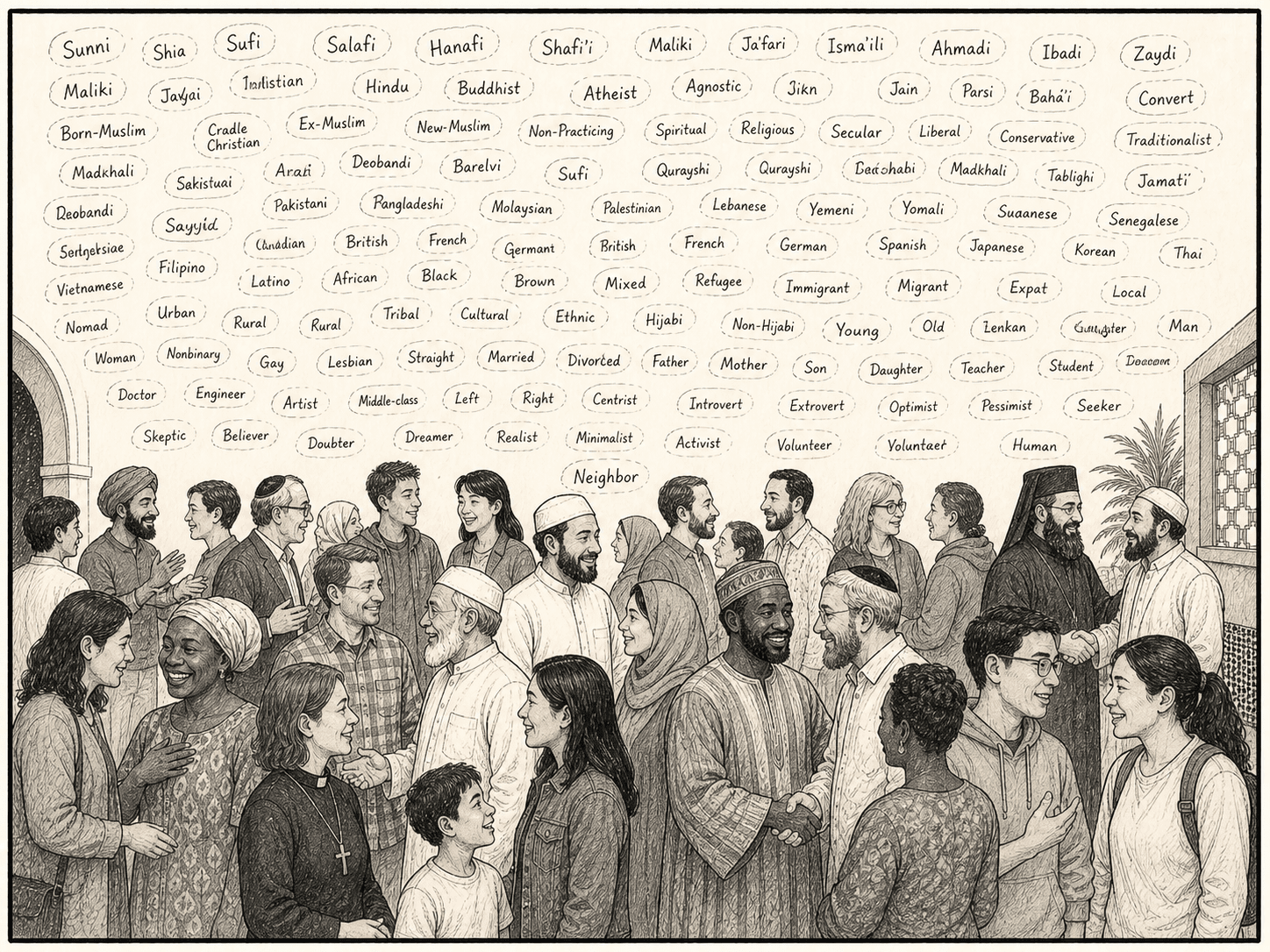
The wider world. Religion, sect, school, ethnicity, profession, posture — everyone labels everyone, and themselves.

Even between two Muslims who have just said salam to each other, the labels run quietly underneath.
ii. The Divine Label

One name. Two conditions. Asked as a gradient — the extent to which, not pass or fail.
Two ways to sort a person
What I would have used
Useful for finding each other. Not for ranking each other.
What He used
مُسْلِم
muslim
aslama wajhahu lillah
submitted his face to Allah
wa huwa muhsin
while being a doer of good
One name. Two conditions. No tribe in the door.
Allah gave us one name and two conditions. We took that and built a thousand sublabels on top. Religions inside religions. Schools inside religions. Lineages inside schools. Ethnicities and nationalities and stances and personalities laid in over the rest. Why do we do this? I think because the simple version asks more of us than the complicated one. Aslama wajhahu lillahi wa huwa muhsin is a daily test. The labels I stack on top of it are a daily comfort — they identify me without examining me. Allah made it simple. We are the ones who made it hard.
Everyone Who Was Called a Muslim
That one name He gave us — He did not give it only once. He used it across 23 ayahs, naming specific people in specific moments. A prophet’s deathbed prayer. The disciples of another prophet. A queen. A household before its destruction. Even Pharaoh, in the last conscious moment of his life. The list is the proof of what 2:112 already said. This is a posture, not a passport.
Everyone the Quran calls a Muslim
The first time I really sat with this list, I had to stop and read it twice. Ibrahim عليه السلام and Ismail عليه السلام, side by side at the Ka’bah, asking Allah to make them muslims (2:128). Yaqub عليه السلام on his deathbed telling his sons not to die except as muslims (2:132). Nuh عليه السلام — Nuh, the one before everyone — saying he was commanded to be among the muslims (10:72).
The first ayah I want to sit with is the line about Ibrahim. It refuses to fit inside any tribal box.
Ibrahim — Neither Jew Nor Christian
Loading 3:67…
Ibrahim عليه السلام is older than both of those traditions. The Quran does not let him be claimed by either. He is a hanif — one inclined to truth, away from idolatry — and a muslim. Whatever the modern conversation about who owns Abraham, the Quran answered the question before we got around to having it.
The disciples of Isa عليه السلام come next. The text uses their own voices. They are speaking, in their own time and language, about themselves.
The Disciples of Isa
Loading 5:111…
They were not Muslims by any modern label. They followed Isa عليه السلام. But the Quran has them say we are muslims — bi-anna muslimoon — and it has them say it twice (the same line appears in 3:52). The word, when Allah uses it, includes them. That is the line where my categories start to crack.
Then Yusuf عليه السلام, at the end of his story. After the pit, the prison, the years away from his father, the reunion. After everything has resolved. His final dua is one line.
Yusuf's Final Prayer
Loading 12:101…
He doesn’t ask to be powerful, doesn’t ask to be remembered, doesn’t ask to be vindicated. He asks to die as a muslim, and to be joined with the righteous. Whatever else he became — minister, brother, son, prophet — the only thing he wanted to take with him into death was the posture.
And then there are the rest. The believers, told to say we are muslims. The magicians of Pharaoh, the moment they understood what they were seeing. The Queen of Sheba, after Sulayman’s court astonished her. The household of Lut عليه السلام before the destruction. Believing men and believing women, side by side. The supplicant for parents. The caller to Allah. Each one named muslim by Allah Himself, in plain succession.
What the list confirms: the word does exactly what 2:112 promised it would. It travels — across centuries, geographies, scriptures. Different mouths, different languages, different prophets — same word. The qualification never changes. The man-made labels — Jew, Christian, Hanif, and the labels we stack on top of muslim ourselves — never gate it. Aslama wajhahu lillahi wa huwa muhsin. That is the door. Anyone in any age can walk through it.
Even Pharaoh, At The End
The list of people Allah called muslims is moving on its own. The case that has always unsettled me is the one where the word is reached for but the reaching is rejected. Pharaoh. The villain of the longest story in the Quran. The Quran shows him drowning. Watch what he reaches for.
Pharaoh, Drowning
Loading 10:90…
He says it. Innee mina al-muslimeen. I am of the muslims. The same word the believers use. The same word Yusuf عليه السلام asks to die under. The same word the disciples of Isa عليه السلام bear witness to. Pharaoh reaches for it.
And the very next ayah tells him no. The submission is rejected.
The Rejection
Loading 10:91…
Read this against 2:112 and the rejection makes sense in a way that pure timing does not. 2:112 set two conditions for the word: aslama wajhahu and wa huwa muhsin. Pharaoh, in his last conscious moment, reaches for the first. He pronounces the surrender. But the second condition is what his life has spent itself erasing. He is the corrupter, the slayer of children, the tyrant who pursued the believers into the sea. There is no muhsin in his ledger.
The word, on its own, is not the door. The word plus the substance is the door. Allah rejects Pharaoh’s last sentence because the second half of the qualification was never there. Innee mina al-muslimeen without muhsinun is a label without the life that earns it. And Allah is not interested in labels.
Note to self: the inverse of Pharaoh is exactly what I do not want to be. Saying the right word, claiming the right name, while the rest of my life is doing something else. The word is not a get-out-of-Hell card. It is a description that has to be true.
What This Means
That has slowly changed what the sentence “I am a Muslim” means, for me, when I hear myself say it. I used to mean: this is the religion I was born into. I now mean, or want to mean: I am today, again, trying to live as one who has submitted his face, and trying to live well while I do. The first version was a fact about my biography. The second is a claim I have to keep making true.
What stays with me: Allah did not see the categories I was raised inside. He sees the two conditions. Aslama wajhahu lillahi wa huwa muhsin. The first time He uses the word, He defines it. The labels I would have stacked on top of myself — the religions I was sorting people by, the tribes I was sorting myself into — He is not sorting by. The work is to stop confusing the two.
At its core, after every layer of reading, the definition stays the same. Two things. Submit to Allah. Do good. That is the whole of it. Everything else — the sects, the schools, the lineages, the labels — is something we added on top.
The sentence I want to leave with is the one that started this. Bala. On the contrary. Not the labels. The labels are mine. The qualification is His. Aslama wajhahu lillahi wa huwa muhsin. Submit. Do good. That is what He named us for.